 Highlight Of Package
offered features
Overviews
Experience the Essence of Nepal
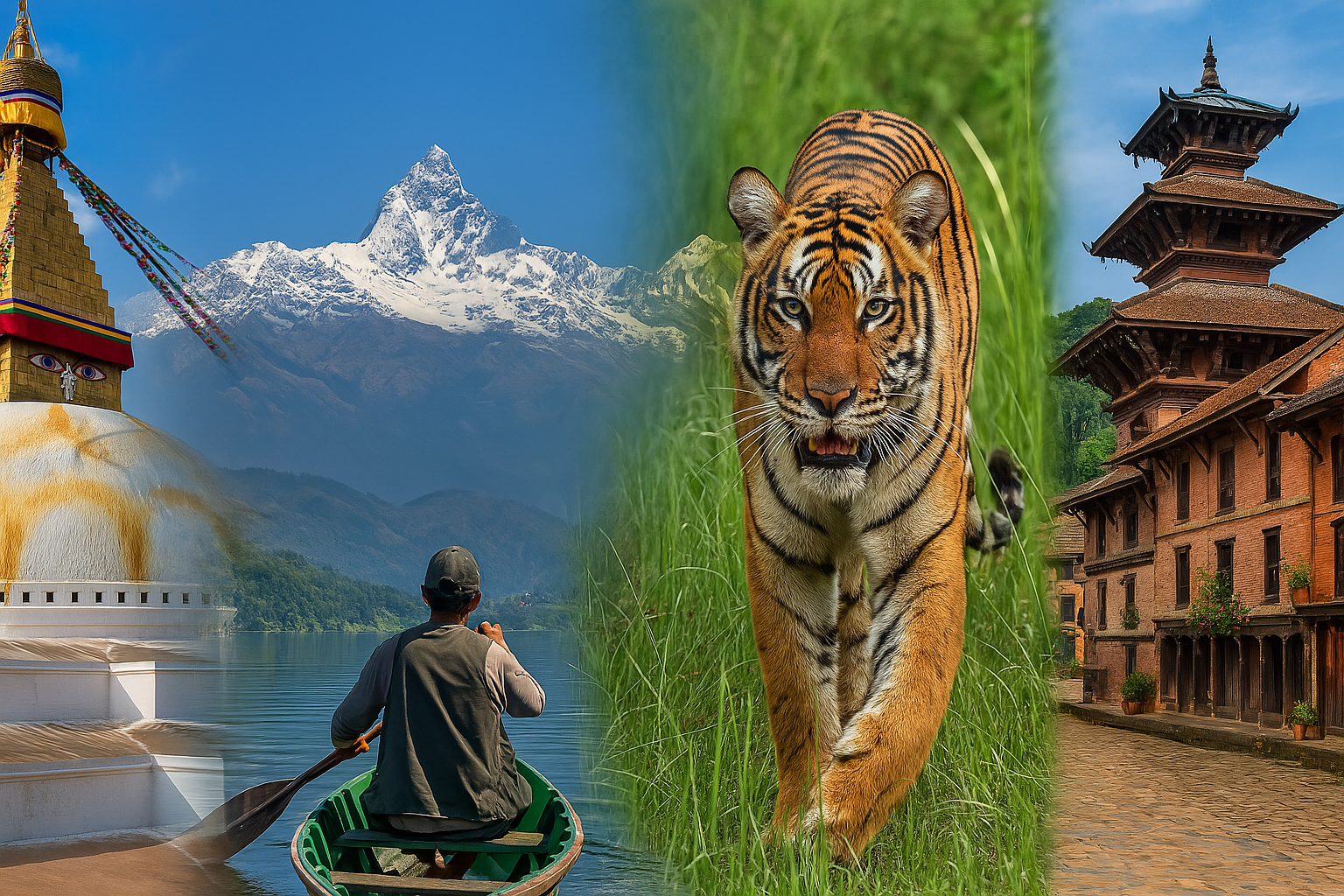
Nepal is a land of breathtaking landscapes, ancient cultural heritage, and unparalleled adventure. This meticulously crafted 11-day journey takes you through the heart of the Himalayas, from bustling cities rich in history to serene natural wonders and sacred sites of global significance. You will explore the vibrant capital of Kathmandu, where centuries-old temples, intricate architecture, and lively markets create an enchanting atmosphere, offering a glimpse into Nepal’s deep-rooted traditions and spiritual essence.
Venture on an unforgettable adventure through the lush jungles of Chitwan National Park, home to a diverse range of wildlife, including the rare one-horned rhinoceros and elusive Bengal tiger. Experience the timeless charm of Bandipur, a picturesque hilltop town that preserves the authenticity of Nepalese culture with its cobbled streets, traditional houses, and panoramic mountain views.
Gaze at the magnificence of the Annapurna range from Pokhara, a city renowned for its stunning lakes, cascading waterfalls, and serene ambiance. Enjoy a tranquil boat ride on Phewa Lake, witness the sunrise over the Himalayas from Sarangkot, and explore mysterious caves and ancient temples that hold centuries of history within their walls.
Your journey then takes you to Lumbini, the revered birthplace of Lord Buddha. Walk in the footsteps of the Enlightened One as you explore sacred monasteries, meditation centers, and the Maya Devi Temple, a UNESCO World Heritage Site that marks the exact spot of his birth. The spiritual serenity of Lumbini provides a moment of deep reflection and understanding of Nepal’s diverse traditions and religious significance.
This well-curated itinerary strikes a perfect balance between cultural immersion, adventure, and relaxation, offering something for every traveler. Whether you seek the thrill of outdoor exploration, the solace of sacred sites, or the richness of Nepal’s history, this tour ensures an enriching experience that caters to your every interest.
Throughout your journey, enjoy seamless logistics, comfortable accommodations, and expert local guidance, ensuring a hassle-free and deeply engaging travel experience. Be prepared to be captivated by Nepal’s warm hospitality, where the stunning contrasts of ancient and modern, mountains and plains, spirituality and adventure, create a travel experience unlike any other.
Herein after are detailed explanations of some of the prominent attractions Nepal offers to its incomers.
Kathmandu Durbar Square (UNESCO World Heritage Site)

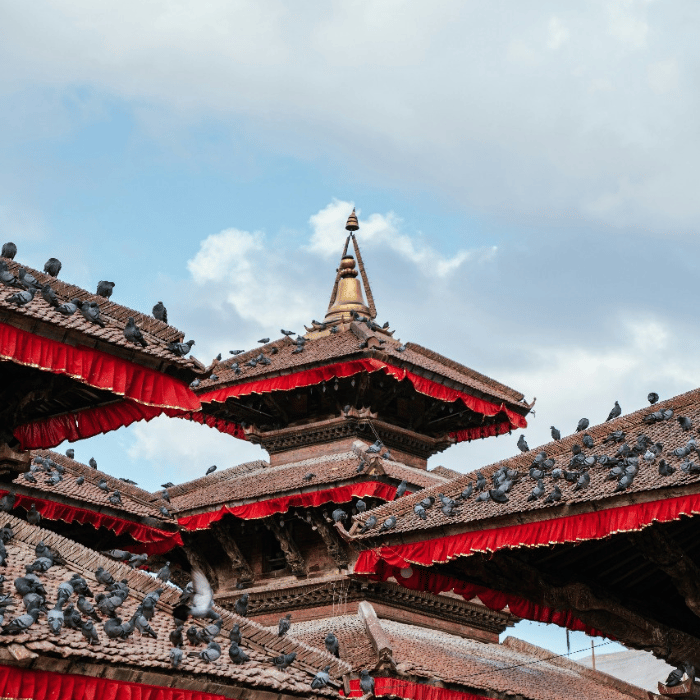
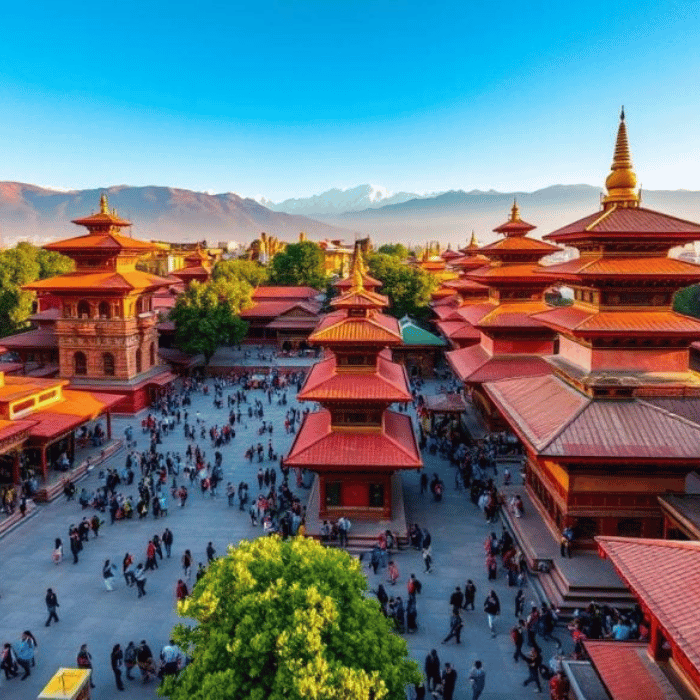
Kathmandu Durbar Square, a UNESCO World Heritage Site, is a magnificent testament to Nepal’s rich history and architectural grandeur. Located in the heart of Kathmandu, this historic square was once the royal palace complex of the Malla kings and later the Shah dynasty, serving as the political and cultural hub of the Kathmandu Valley. The square is an open-air museum of ancient temples, shrines, courtyards, and intricate wood carvings that reflect the artistic brilliance of the Newar civilization.
One of the most iconic structures within the square is Hanuman Dhoka Palace, named after the Hindu monkey god Hanuman, whose statue guards the entrance. This palace complex, dating back to the 16th century, houses several courtyards, royal chambers, and museums that offer a glimpse into Nepal’s regal past. The elaborately carved doors and windows of the palace showcase the exceptional skills of the artisans of the time.
Another highlight is the Kumari Ghar, the residence of the Living Goddess, Kumari. This beautifully designed three-story structure features intricate wood carvings and is home to a young girl chosen as the living embodiment of the goddess Taleju. Visitors may catch a rare glimpse of the Kumari as she appears at the window during special ceremonies.
The square is also adorned with numerous temples dedicated to Hindu and Buddhist deities. The Taleju Temple, towering over the complex, is one of the oldest and most revered temples, dedicated to Goddess Taleju Bhawani. The Jagannath Temple, with its erotic carvings, and the Shiva-Parvati Temple, featuring the divine couple gazing down at the square, add to the spiritual allure of the site.
Despite suffering significant damage during the 2015 earthquake, Kathmandu Durbar Square remains a vibrant cultural and religious hub. Restoration efforts have preserved its grandeur, allowing visitors to experience the timeless charm of Nepal’s royal history. Whether admiring the artistic marvels, exploring the hidden courtyards, or simply soaking in the atmosphere of this historic square, Kathmandu Durbar Square offers an unforgettable journey into Nepal’s glorious past.
Bhaktapur Durbar Square (UNESCO World Heritage Site)

Bhaktapur Durbar Square, a UNESCO World Heritage Site, is a remarkable testament to Nepal’s medieval history, rich culture, and architectural brilliance. Located in the heart of Bhaktapur, this historic square was once the royal palace complex of the Malla kings, who ruled the Kathmandu Valley from the 12th to the 18th century.
One of the most iconic structures in Bhaktapur Durbar Square is the Nyatapola Temple, a five-story pagoda built in 1702 by King Bhupatindra Malla. It is Nepal’s tallest temple and has withstood multiple earthquakes, a testament to its superior engineering. Each level is guarded by pairs of stone figures, symbolizing increasing strength.
The 55-Window Palace, another highlight, was the royal residence for centuries. Built in the 15th century and later renovated by King Bhupatindra Malla in the 17th century, the palace is famous for its intricately carved wooden windows. The Golden Gate, which serves as the entrance to the palace, is considered one of the most beautiful gates in South Asia, featuring detailed gilded decorations.
The Vatsala Temple, made of sandstone, is another striking monument, known for its delicate carvings and a silver bell, called the "Bell of Barking Dogs," which was rung by devotees and also used to call for justice during the Malla era.
Bhaktapur Durbar Square is not just a historical site but also a living museum where traditional artisans—potters, woodcarvers, and weavers—still practice centuries-old crafts. The square comes alive during festivals like Bisket Jatra, a grand New Year celebration unique to Bhaktapur.
With its rich history, stunning architecture, and vibrant cultural traditions, Bhaktapur Durbar Square remains one of Nepal’s most treasured heritage sites.
Patan Durbar Square (UNESCO World Heritage Site)

Patan Durbar Square, a UNESCO World Heritage Site, is a stunning showcase of Nepalese art, culture, and Newar architecture. Located in the heart of Lalitpur, this historic square was once the royal palace of the Malla kings and remains a center of religious and artistic heritage.
One of the most striking features of Patan Durbar Square is the Krishna Mandir, a masterpiece of stone architecture built by King Siddhi Narsingh Malla in the 17th century. Dedicated to Lord Krishna, this temple is unique for its entirely stone-carved structure, intricate sculptures, and 21 pinnacles.
The Royal Palace Complex is another highlight, consisting of three main courtyards: Mul Chowk, Sundari Chowk, and Keshav Narayan Chowk. These courtyards are adorned with finely carved windows, doors, and shrines. Sundari Chowk houses the Tusha Hiti, an exquisitely decorated royal bath with intricate stone carvings.
The square is home to several other remarkable temples, including the Bhimsen Temple, dedicated to the god of trade and business, and the Hiranya Varna Mahavihar (Golden Temple), a revered Buddhist monastery with golden facades and a richly decorated interior.
Patan Durbar Square is also known for its thriving artisan community. The city has long been a hub for metalwork, wood carving, and traditional Thangka paintings. Visitors can explore its narrow alleys to witness craftsmen working on exquisite bronze and copper statues.
The square becomes especially lively during festivals like Krishna Janmashtami, when thousands of devotees gather at Krishna Mandir. With its blend of history, art, and spirituality, Patan Durbar Square remains a living heritage site that continues to captivate visitors from around the world.
Lumbini – The Birthplace of Lord Buddha (UNESCO World Heritage Site)

A journey to Lumbini is a profound spiritual experience, taking visitors to the birthplace of Lord Buddha, the founder of Buddhism. This UNESCO World Heritage Site, nestled in the Rupandehi district of Nepal, is one of the most revered pilgrimage destinations for Buddhists worldwide.
At the heart of Lumbini lies the Maya Devi Temple, marking the exact spot where Queen Maya Devi gave birth to Prince Siddhartha Gautama in 623 BCE. The temple houses ancient ruins and a sacred stone that identifies the precise birthplace. Nearby, the Ashoka Pillar, erected by Emperor Ashoka in the 3rd century BCE, stands as undeniable evidence of Lumbini’s historical and spiritual significance.
Lumbini is also home to a vast monastic zone, featuring magnificent monasteries built by Buddhist communities from around the world. The Chinese, Thai, Myanmar, and German monasteries showcase diverse architectural styles, reflecting the global influence of Buddhism. The World Peace Pagoda, built by Japanese monks, symbolizes peace and harmony.
The Sacred Pond (Puskarini), where Queen Maya Devi is believed to have bathed before giving birth, remains an important site for pilgrims. Another serene attraction is the Lumbini Museum, which exhibits ancient artifacts, scriptures, and relics related to Buddhism.
With its deep spiritual essence, tranquil gardens, and centuries-old history, Lumbini offers an enlightening journey for visitors seeking inner peace and a connection to Buddha’s teachings.
Swayambhunath Stupa (Monkey Temple)

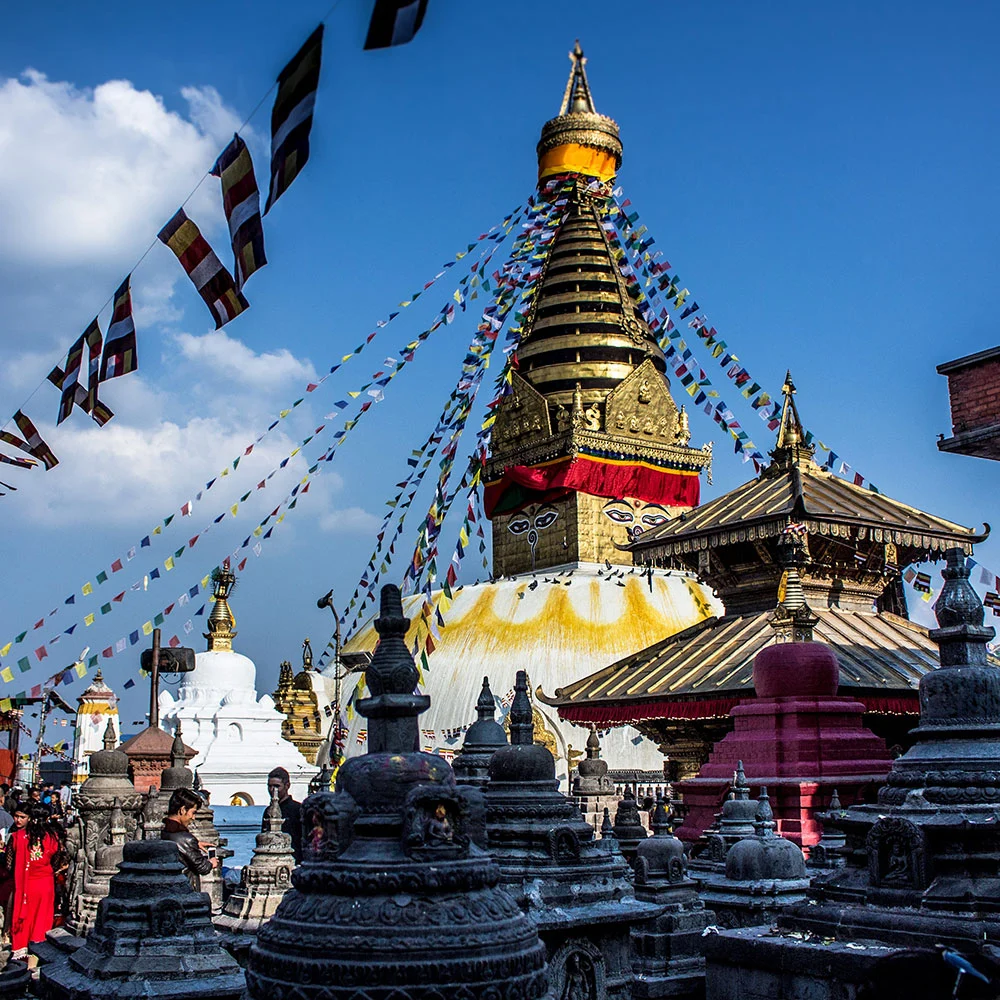
Perched atop a hill in the Kathmandu Valley, Swayambhunath is one of Nepal’s most revered spiritual sites and a significant historical monument. Commonly known as the "Monkey Temple" due to the large population of monkeys inhabiting the area, Swayambhunath is a symbol of Buddhist faith and harmony. The stupa, adorned with the watchful eyes of Buddha, overlooks the valley, signifying wisdom and enlightenment.
As a spiritual sanctuary, Swayambhunath holds deep religious importance for both Buddhists and Hindus. According to legend, the site emerged from a primordial lake when the Bodhisattva Manjushri cut a gorge to drain the water, revealing the self-existent stupa. The stupa’s golden spire, fluttering prayer flags, and surrounding shrines create an atmosphere of devotion, attracting pilgrims and visitors seeking blessings and peace.
Historically, Swayambhunath dates back over 2,500 years, making it one of the oldest Buddhist sites in Nepal. It has been a center of worship, meditation, and learning for centuries. The architecture of the stupa, with its dome symbolizing the world and the thirteen tiers representing the stages to enlightenment, reflects Buddhist cosmology. Additionally, the complex houses monasteries, chaityas, and statues that depict the fusion of Hindu and Buddhist traditions.
Beyond its religious significance, Swayambhunath offers breathtaking panoramic views of Kathmandu, making it a cultural and visual treasure. The rhythmic chants, the scent of incense, and the sight of devotees spinning prayer wheels enhance the spiritual experience. Whether one visits for faith, history, or reflection, Swayambhunath remains a timeless beacon of enlightenment, unity, and serenity in Nepal’s rich heritage.
Pashupatinath Temple (UNESCO World Heritage Site)

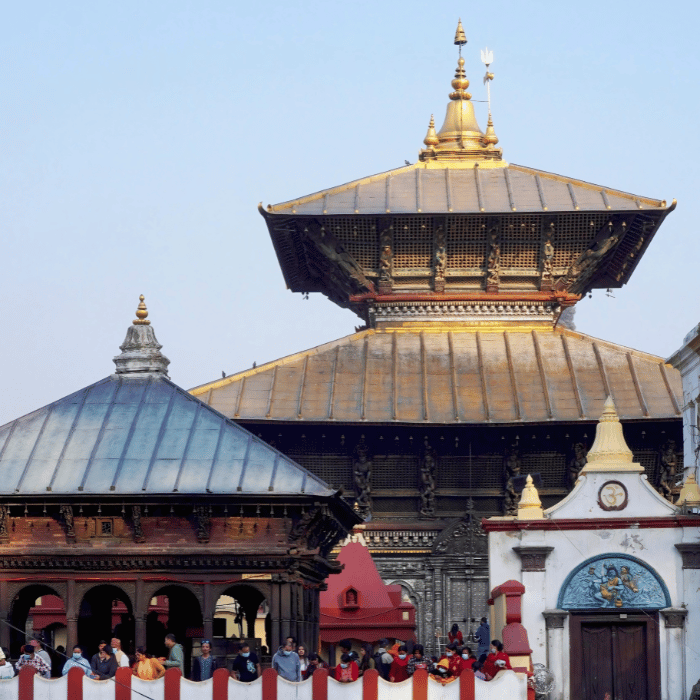
Pashupatinath, located on the banks of the Bagmati River in Kathmandu, is one of the holiest Hindu temples dedicated to Lord Shiva. As a UNESCO World Heritage Site, it holds immense spiritual and historical significance, attracting devotees and visitors from around the world. The temple complex is a masterpiece of ancient Nepalese architecture, with its golden pagoda-style roof, intricately carved wooden doors, and sacred linga (symbol of Shiva) enshrined within the main temple.
As a spiritual space, Pashupatinath is a center of deep devotion and rituals. Hindus believe that visiting the temple and offering prayers to Lord Shiva brings blessings and liberation from the cycle of birth and death. The site is especially vibrant during Maha Shivaratri, when thousands of devotees, including sadhus (holy men) from across South Asia, gather for prayers and ceremonies. The atmosphere is filled with the sound of bells, Vedic chants, and the fragrance of burning incense, creating a profoundly spiritual experience.
Historically, Pashupatinath has stood for centuries as a testament to Nepal’s religious and cultural heritage. The earliest records of the temple date back to the 5th century, though it is believed to be much older. The temple complex includes numerous shrines, ashrams, and sculptures reflecting Nepal’s rich artistic traditions. The Bagmati River, which flows beside the temple, is considered sacred, and its ghats (stone steps) serve as a site for cremation ceremonies, signifying the Hindu belief in life, death, and rebirth.
Beyond its religious importance, Pashupatinath is a place of introspection and peace. The serene environment, combined with the spiritual energy of the temple, offers visitors a glimpse into the depth of Hindu faith and Nepal’s ancient traditions.
Boudhanath Stupa (UNESCO World Heritage Site)

Boudhanath, one of the largest and most significant Buddhist stupas in the world, stands as a symbol of peace, spirituality, and cultural harmony. Located in Kathmandu, this UNESCO World Heritage Site is a sacred pilgrimage destination for Buddhists, particularly Tibetan Buddhists, and a serene refuge for meditation and prayer. The massive white dome, crowned with a golden spire and adorned with Buddha’s all-seeing eyes, represents enlightenment and universal compassion.
As a spiritual center, Boudhanath is a hub of devotion and Buddhist practices. The stupa is surrounded by prayer wheels, monasteries, and shops selling traditional Tibetan artifacts, creating a deeply immersive experience. Pilgrims and visitors walk clockwise around the stupa, chanting prayers and spinning prayer wheels, believing it brings blessings and good karma. The rhythmic chants of monks, the fluttering prayer flags, and the scent of incense make Boudhanath a place of tranquility and introspection.
Historically, Boudhanath dates back to the 5th or 6th century and has long been a key site along ancient trade routes connecting Nepal and Tibet. It became an important center of Tibetan Buddhism, especially after Tibetan refugees settled in the area following the Chinese occupation of Tibet in the 1950s. Today, the surrounding streets are lined with monasteries representing different Tibetan Buddhist traditions, reinforcing the stupa’s role as a spiritual and cultural melting pot.
Beyond its religious significance, Boudhanath offers a serene escape from the bustle of Kathmandu. The stupa’s majestic presence, combined with the peaceful energy of its surroundings, provides visitors with a sense of harmony and reflection. Whether for worship, meditation, or cultural appreciation, Boudhanath remains a timeless beacon of Buddhist faith, wisdom, and serenity.
Chitwan National Park (UNESCO World Heritage Site)

Chitwan National Park, Nepal’s first national park, is a UNESCO World Heritage Site renowned for its rich biodiversity and conservation efforts. Located in the subtropical lowlands of southern Nepal, the park spans over 950 square kilometers, offering a sanctuary for diverse wildlife, lush forests, and vibrant ecosystems. It is one of the best places in Asia to experience the wilderness up close, making it a top destination for nature enthusiasts and adventure seekers.
As a haven for wildlife, Chitwan National Park is home to rare and endangered species, including the one-horned rhinoceros, Bengal tiger, gharial crocodile, and Asian elephant. The park’s rivers, grasslands, and dense sal forests support a variety of birds, reptiles, and mammals, creating an ecological paradise. Visitors can explore the park through jungle safaris, canoe rides, and nature walks, offering a chance to witness the beauty and majesty of Nepal’s wildlife in its natural habitat.
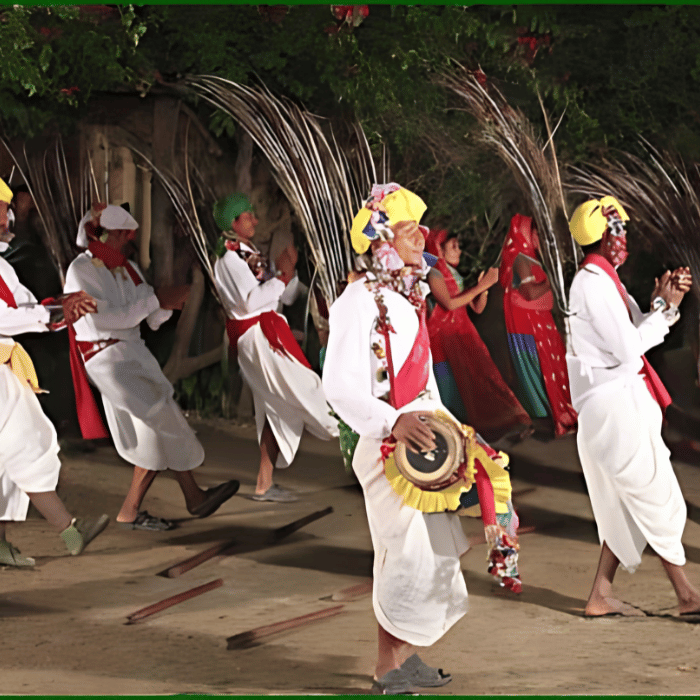
Beyond its ecological importance, Chitwan is also rich in cultural heritage. The indigenous Tharu community has lived in harmony with the region’s wildlife for centuries. Their unique traditions, dances, and way of life add a cultural dimension to the park experience. Many visitors engage in village tours to learn about the Tharu people's deep connection with nature and their sustainable way of living.
Chitwan National Park is not just a place for adventure but also a crucial site for conservation. Efforts to protect its endangered species and preserve its natural beauty make it a model for sustainable tourism. Whether for thrilling wildlife encounters, cultural exploration, or peaceful immersion in nature, Chitwan remains a remarkable destination that showcases Nepal’s commitment to biodiversity and environmental stewardship.
Pokhara & the Annapurna Range

Pokhara is a paradise for nature lovers, with its stunning backdrop of snow-capped peaks. Enjoy a serene boat ride on Fewa Lake, visit the mysterious Gupteshwor Cave, and marvel at the cascading Davis Falls. Sunrise from Sarangkot offers breathtaking panoramic views of the Annapurna and Dhaulagiri mountain ranges.
✅ Expert local guides with deep knowledge of Nepal.
✅ Flexible and customizable itineraries.
✅ Competitive pricing with no hidden costs.
✅ Commitment to responsible tourism and authentic experiences.
Cost Include
1) Star Accommodation in Kathmandu, Pokhara, Chitwan, Lumbini, Bandipur and Bhaktapur
2) All Entry Fees and Permits
3) Guidance and Assistance
4) Meals on Full Board Basis ( Breakfast, Lunch and Dinner)
5) Private Transportation Kathmandu-Chitwan-Bandipur-Pokhara-Lumbini-Bhaktapur
6) Air tickets for Lumbini-Kathmandu\
7) All Airport transfers
Cost Exclude
Itinerary
Upon arrival at Tribhuvan International Airport in Kathmandu, you will be greeted and transferred to your hotel, a journey of approximately 20–30 minutes depending on traffic. As you make your way through the city, you’ll witness the vibrant blend of ancient culture and modern urban life. The streets are filled with the sounds of honking motorbikes, the scent of incense from nearby temples, and the sight of intricately carved pagodas standing alongside bustling markets. After checking in at your hotel, you can take the rest of the day to relax or explore the nearby streets, immersing yourself in the lively energy of Nepal’s capital city.
Today is dedicated to exploring the cultural and historical treasures of Kathmandu. You will visit UNESCO World Heritage Sites, starting with Swayambhunath Stupa (Monkey Temple), perched on a hilltop offering panoramic views of the Kathmandu Valley. Next, you’ll explore Kathmandu Durbar Square, where ancient palaces, courtyards, and temples narrate the city’s rich history. The journey continues to Pashupatinath Temple, Nepal’s holiest Hindu shrine, where you may witness cremation rituals along the Bagmati River. Finally, you’ll visit Boudhanath Stupa, a majestic Buddhist monument surrounded by prayer wheels and chanting monks. The day ends with leisure time at Thamel, a lively tourist hub filled with restaurants, souvenir shops, and music bars.
After breakfast, you will venture on a scenic drive to Chitwan, descending from the Kathmandu Valley along winding roads with breathtaking views of lush hills, deep gorges, and rivers. The route follows the Trishuli River, where you may spot adventure seekers rafting in its rapids. As you approach Chitwan, the landscape transitions into flat plains and dense forests, characteristic of Nepal’s subtropical lowlands. Upon arrival, you will check into a jungle lodge or resort near Chitwan National Park, where the evening is free to relax and enjoy the tranquil surroundings.
Today, you will explore Chitwan National Park, home to diverse wildlife, including the rare one-horned rhinoceros, Bengal tigers, elephants, and crocodiles. The day begins with a thrilling jeep or elephant safari through the dense jungle, crossing open grasslands, rivers, and sal forests. You will also enjoy a canoe ride along the Rapti River, where you can spot crocodiles basking in the sun and various bird species. In the evening, you’ll experience the Tharu Cultural Dance, a lively performance by the indigenous Tharu community showcasing their unique traditions and rhythmic dances around a bonfire.
Leaving Chitwan, you will drive to Bandipur, a picturesque hilltop town known for its well-preserved Newari culture and stunning mountain views. The journey takes you through charming countryside roads, past terraced fields and small villages. As you ascend towards Bandipur, the air becomes cooler, and the scenery transforms into rolling hills covered in lush forests. Upon arrival, you’ll check into a guesthouse and explore the beautifully preserved town, walking through stone-paved alleys lined with traditional wooden houses. In the evening, enjoy breathtaking sunset views over the Himalayas.
After a peaceful morning in Bandipur, you will continue your journey to Pokhara, one of Nepal’s most scenic destinations. The drive descends through winding roads, offering glimpses of rural life, terraced farmlands, and distant mountain peaks. As you approach Pokhara, the landscape opens up to reveal the serene Phewa Lake with the Annapurna and Machhapuchhre (Fishtail) mountains in the backdrop. After checking into your lakeside hotel, you can take a leisurely walk along the waterfront, enjoying the relaxed vibe of the city.
Today is all about exploring the natural beauty of Pokhara. Early in the morning, you will drive to Sarangkot, a hilltop viewpoint offering stunning sunrise views over the Annapurna and Dhaulagiri mountain ranges. After breakfast, you will visit Davis Falls, a powerful waterfall that disappears into an underground tunnel, followed by a visit to Gupteshwor Cave, a sacred site with a Shiva temple inside. The tour continues with a boat ride on Phewa Lake, where you can visit Tal Barahi Temple, situated on a small island. Later, explore the International Mountain Museum and the Peace Pagoda, a hilltop Buddhist stupa with panoramic views of Pokhara.
Leaving the cool climate of Pokhara behind, you will drive towards Lumbini, the birthplace of Lord Buddha. The journey takes you through winding mountain roads, gradually descending into the flat plains of Nepal’s Terai region. Along the way, you’ll pass through traditional villages, forests, and agricultural fields. Upon arrival in Lumbini, check into your hotel and relax after the long journey. The evening can be spent strolling around the peaceful surroundings of the Lumbini Garden.
Today, you will explore the sacred sites of Lumbini, beginning with the Maya Devi Temple, where Buddha was born. Surrounding the temple, you’ll find ancient ruins and the Ashoka Pillar, erected by Emperor Ashoka in the 3rd century BCE. The visit includes the monastic zone, home to beautiful monasteries built by different Buddhist communities worldwide. The serene environment, with chanting monks and prayer flags fluttering in the breeze, creates a spiritually uplifting experience. The day concludes with a visit to the Lumbini Museum, which showcases artifacts and historical records related to Buddhism.
After breakfast, you will drive to Bhairahawa airport to take a short domestic flight from Lumbini to Kathmandu, offering aerial views of Nepal’s diverse landscapes. The duration of this flight is 30minutes where you will fly parallel to the northern Himalayan mountains. Upon arrival, you will drive to Bhaktapur, an ancient city known for its well-preserved medieval architecture. Walking through Bhaktapur Durbar Square, you will see intricately carved temples, palaces, and courtyards that reflect the grandeur of the Malla dynasty. Highlights include the 55-Window Palace, Nyatapola Temple, and Pottery Square, where artisans craft traditional clay pots. The peaceful ambiance of Bhaktapur provides a perfect setting to reflect on your journey.
On your final day, depending on your flight schedule, you can spend the morning enjoying a relaxed breakfast or exploring the local markets for souvenirs. You will then be transferred to Tribhuvan International Airport for your departure, taking with you unforgettable memories of Nepal’s diverse landscapes, rich culture, and warm hospitality.
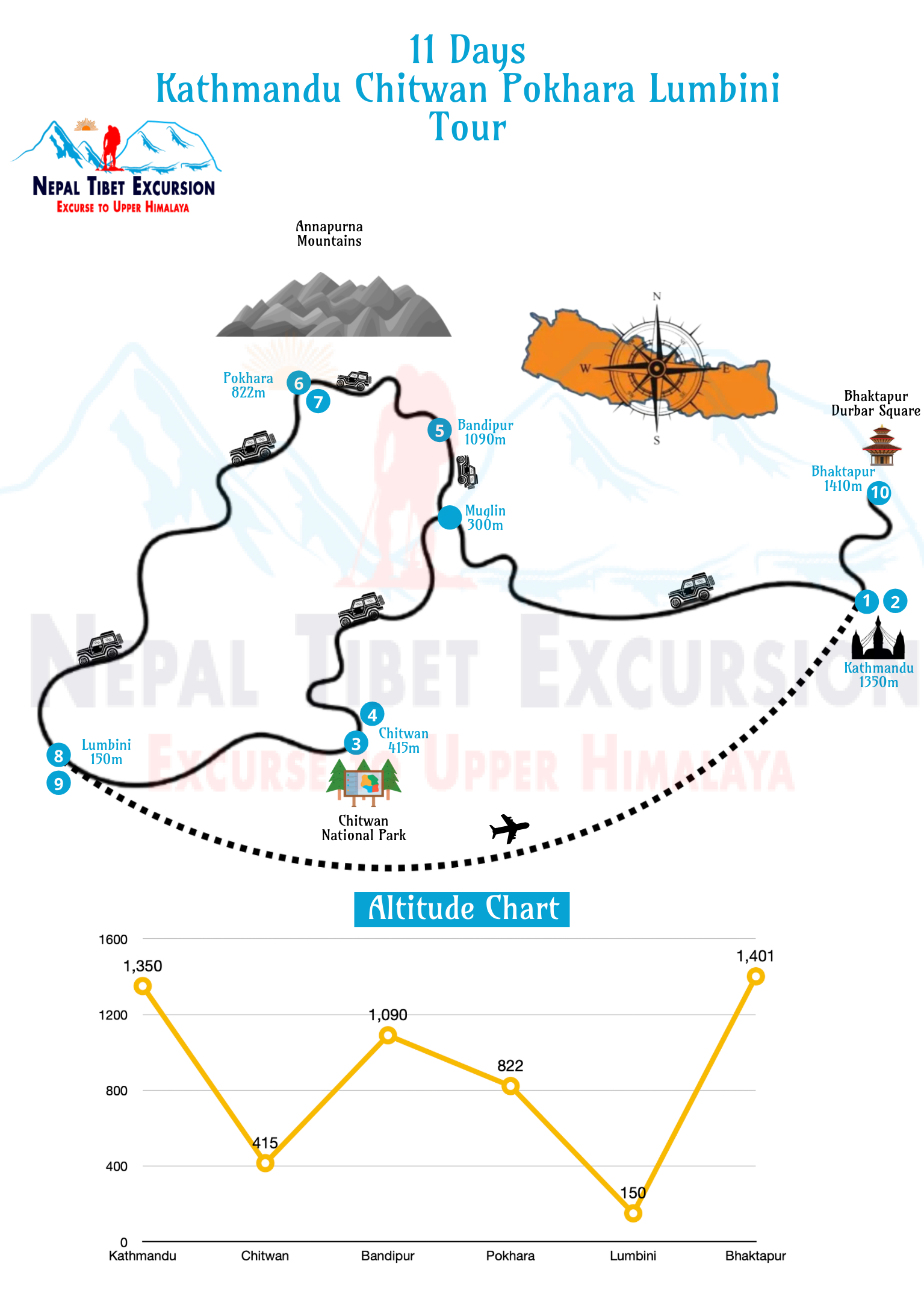
Route Map For Kathmandu Pokhara Chitwan Lumbini Tour 11 Days
 Frequently Asked Questions
Group Join Discount
| Nos Of Persons | price per person |
|---|
Up Coming Fixed Departure
| Trip Name | Departure Date | Price | Trip Status | Action |
|---|
Package Reviews And Rating
Write Reviews
Enquiry For Further Information